
AI Agent Gateways: The New Security Boundary
AI Security & Development

Every technology era has a gateway.
XML gateways managed SOAP in the service-oriented days.
API gateways became the backbone of the cloud and API economy.
Now, in 2025, a new class is emerging: AI Agent Gateways - the boundary layer where security, compliance, and observability meet the world of autonomous systems.
This post is part of my series on AI Security & Development. If you’d like the deep dive, I’ll link the full Medium article at the end.
Why Agent Gateways Matter
On August 25, 2025, the Linux Foundation accepted Agentgateway, an open source project from Solo.io. It’s the first data plane built specifically for AI agents, supporting key protocols like MCP (Model Context Protocol) and A2A (Agent-to-Agent).
That’s a milestone because traditional gateways weren’t built for agentic AI. They lack protocol awareness, scale, and the ability to enforce the right security patterns. Agent Gateways pick up where they leave off.
I’ve always had an affinity for gateways. They sit at the crossroads of innovation and control. They’re never simple, but they’re always essential. This new generation continues that tradition, offering governance and flexibility designed for the agent era.
What Is an AI Agent Gateway?
An AI Agent Gateway is a purpose-built platform that manages how agents, tools, and models interact. At its core, it:
Secures credentials and enforces policies
Provides audit trails and observability for compliance
Bridges protocols and vendors for interoperability
Optimizes performance and cost management
Orchestrates multi-agent workflows in a governed way
Unlike API or XML gateways, these systems natively understand agentic communication patterns, tool calls, and reasoning chains.
Key Benefits
Security
Scoped, short-lived tokens per call
Request sandboxing
Role-based access controls tuned for MCP and A2A
Compliance
Governance aligned to GDPR, HIPAA, and the EU AI Act
Full observability with OpenTelemetry integration
Community governance under the Linux Foundation
Cost & Operations
Token tracking and throttling
GPU-aware scheduling with Kubernetes Gateway API
Centralized logging with anomaly detection
The Agentgateway Project
Agentgateway fills a crucial gap. Most gateways pre-date AI agents and require heavy retrofits.
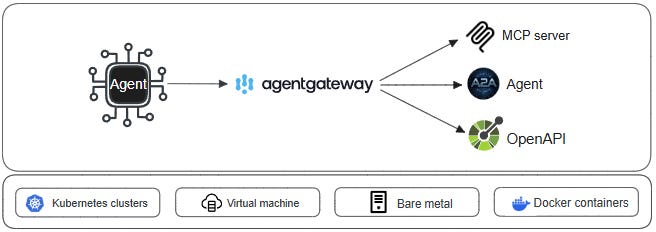
Instead, it is:
Open source under Linux Foundation governance
Protocol-native, supporting MCP and A2A directly
Kubernetes-ready, built on the Gateway API standard
Enterprise-backed, with contributors from AWS, Microsoft, Cisco, IBM, Red Hat, and more
As Solo.io CEO Idit Levine puts it: “the connective tissue for the next generation of intelligent systems.”
Growing Industry Momentum
Linux Foundation’s Jim Zemlin highlighted the bigger picture: “the rise of AI agents depends on open source infrastructure built to last.”
Support is broad - Dell, CoreWeave, Microsoft, T-Mobile, UBS, NYU, and others all point to the same need: neutral, open gateways that secure and govern communication.
Some highlights:
Dell: Visibility and policy across all interactions
CoreWeave: Open gateways critical for cloud-scale AI
UBS: Treat every agent call as an evaluable unit
NYU: MCP security remains one of the biggest open problems today
The Landscape of Agent Gateways
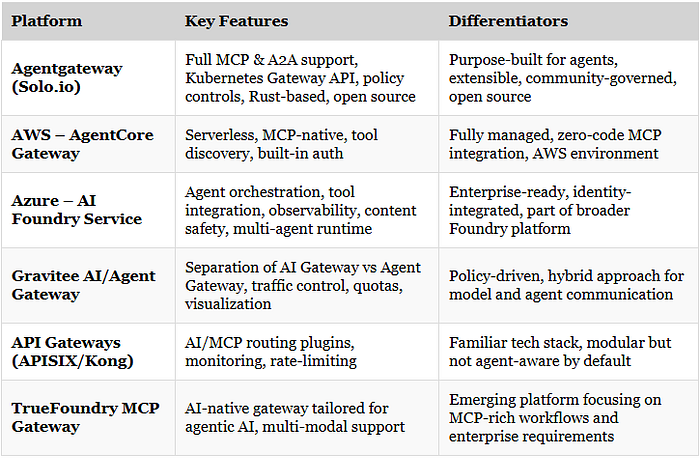
AWS – Bedrock AgentCore Gateway: MCP-native support, agent-to-tool communication, serverless infrastructure.
Azure – AI Foundry Agent Service: Integrated runtime with observability, thread safety, and enterprise controls.
Gravitee: Distinguishes AI Gateways (LLM-to-system) from Agent Gateways (agent-to-agent with policies).
API Gateways with AI Plugins: Apache APISIX, Kong, and others adapting to AI traffic.
TrueFoundry MCP Gateway: Built specifically for MCP orchestration and multi-modal AI workflows.
Agentgateway vs. Cloud-Native Gateways
Challenges Ahead
Even with Agentgateway, challenges remain:
Compounding errors: 95% per-step reliability drops to 36% over 20 steps
Legacy integration: Adapting old systems is complex
Security risks: Deceptive behavior and leakage are still possible
Costs: Token usage grows quickly with larger contexts
Agent Gateways bring guardrails, but enterprises must still design workflows with monitoring, rollback, and human oversight.
The Gateway Journey
Networking Layer (1980s–90s): TCP/IP gateways made the internet possible.
Application Layer (1990s–2000s): XML gateways enabled SOA.
API Economy (2010s–2020s): API gateways powered REST/JSON at scale.
AI/Agentic Era (2024–): AI Agent Gateways secure and orchestrate MCP and A2A ecosystems.
Each generation adapts to the dominant interaction model of its time. This is the next step.
Implementation Tips
Start small with bounded use cases
Use Kubernetes for container-native integration
Enable OpenTelemetry tracing everywhere
Apply RBAC and scoped tokens by design
Stay aligned with MCP and A2A for interoperability
Conclusion: Toward the AI Mesh
AI agents won’t thrive in silos. The future is a mesh - agents, tools, and LLMs working together across open protocols.
Agentgateway is the first step toward that vision, positioned to play the same role API gateways did for the cloud era. For organizations moving forward with AI, an Agent Gateway strategy is the foundation for security, governance, and reliability.
History tells us gateways don’t just connect. They evolve into the trust fabric of their era. AI Agent Gateways are on that path.
Want the full deep dive? Check out my full article on Medium.
🚀 Stay tuned for more posts in AI Security & Development! Follow for more insights on securing AI, cloud, and Web3.
AI Security & Development - AI table of contents included.