
Secure AI Agent Execution: Sandboxes, Guardrails, and the Future of Trustless Code
AI Security & Development


AI agents are no longer just text generators. They can now write, execute, and validate code as part of their workflows. That unlocks powerful use cases in data analysis, automation, and decision-making. But it also brings the riskiest capability we can hand to an AI system: the ability to run arbitrary code.
Code execution is a double-edged sword. Managed well, it accelerates productivity and enables enterprise-scale solutions. Done poorly, it opens the door to privilege escalation, data leaks, and system compromise. That’s why secure execution environments are now at the center of attention for cloud providers, open-source projects, and enterprise teams.
Why Guardrails Are Essential
Letting an AI agent run code means giving it direct influence over systems and data. Without safeguards, the attack surface is wide:
Injection risks: Generated code can include SQL or command injection payloads.
Privilege escalation: Misconfigured roles grant access far beyond what’s intended.
Data leakage: Weak isolation exposes sensitive information.
System compromise: Buggy or malicious code overwhelms resources or alters runtimes.
We’ve already seen this play out. Early “code interpreter” tools allowed arbitrary shell commands without isolation. A simple prompt injection could exfiltrate environment variables and API keys. The lesson is clear: without strong guardrails, enterprise adoption is unsafe.
How the Cloud Providers Handle It
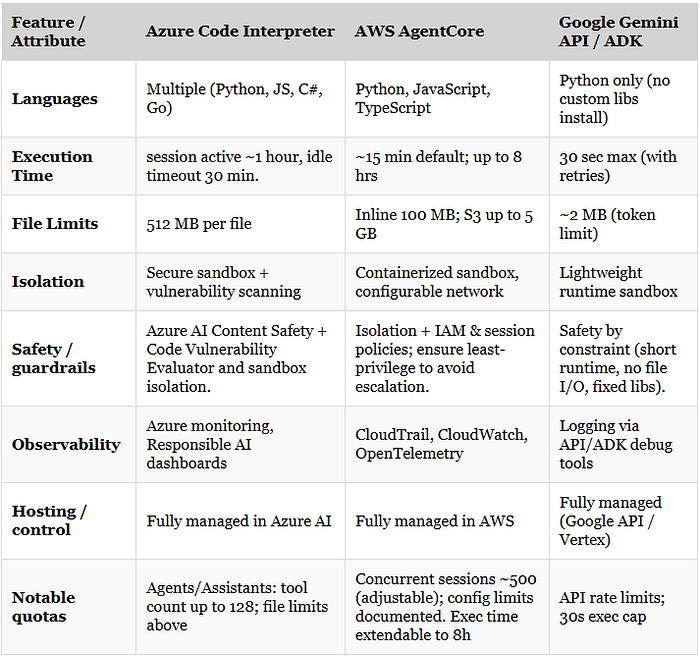
Azure Code Interpreter
Azure emphasizes proactive safety:
Content filtering for harmful input
Code vulnerability scanning
Isolated sandbox execution
Best for regulated industries or teams that want built-in safeguards.
AWS AgentCore
AWS optimizes for flexibility and scale:
Containerized sandboxes with configurable network access
Extended runtimes (up to 8 hours)
Large data support (files to 5 GB via S3)
Observability through CloudTrail, CloudWatch, and OpenTelemetry
Powerful, but places responsibility on teams to configure IAM and privileges carefully.
Google Gemini API / ADK
Google opts for safety through constraints:
Python-only execution
Hard 30-second runtime limit
File size capped at ~2 MB
Automatic retries for resilience
Great for lightweight workflows, less so for heavy enterprise workloads.
Comparison
Emerging Alternatives: AVM and E2B
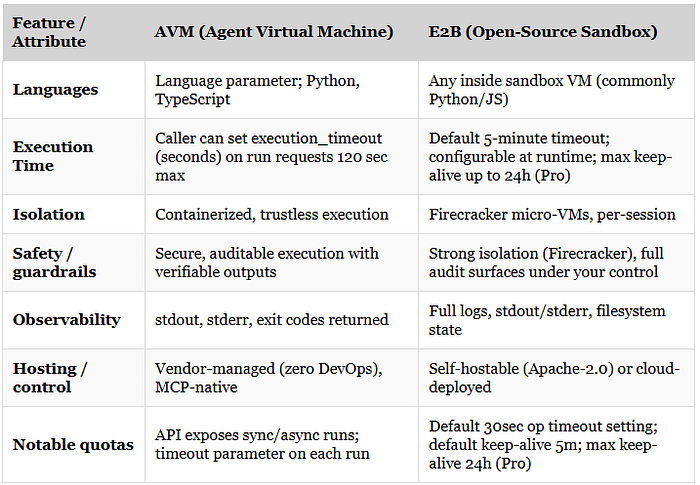
AVM (Agent Virtual Machine)
Built for the “agent economy”:
Trustless, containerized execution
No DevOps overhead (MCP-based API)
Verifiable outputs for compliance pipelines
Think of it as a portable execution layer for multi-agent systems.
E2B (Open Source Sandbox)
Developer-first and self-hostable:
Firecracker micro-VMs spin up in ~150 ms
Full environment control, including packages and internet access
Complete audit trail of logs and file state
Open-source, Apache-2.0 license
Ideal for teams who value transparency and want to avoid vendor lock-in.
Comparison
Security Best Practices
No matter the platform, these are the non-negotiables:
Apply least privilege with IAM roles and network access
Default to offline sandboxes unless online access is essential
Enforce strict execution limits (timeouts, memory, file caps)
Audit everything, and push logs to your monitoring stack
Red team your agents with malicious prompts and payloads
What’s Next: Trustless Execution
The trend is clear:
Cloud providers will continue adding responsible AI guardrails
Independent frameworks will drive portability and transparency
Trustless execution - where every run is verifiable - will become the gold standard
For engineers and security leaders, the mindset must shift. Treat agent execution like any other production workload. Isolation, observability, and governance are the baseline.
Takeaway
Secure execution isn’t optional. It’s the foundation for trustworthy AI systems.
Start with cloud-native interpreters for early experiments. As you scale, move toward portable, auditable sandboxes. And from the beginning, make execution security part of your compliance and monitoring pipelines.
Because in the end, secure AI execution isn’t just another feature - it’s the bedrock for enterprise AI.
Want the full deep dive? Check out my full article on Medium.
🚀 Stay tuned for more posts in AI Security & Development! Follow for more insights on securing AI, cloud, and Web3.
AI Security & Development - AI table of contents included.
Secure AI Agent Execution: Sandboxes, Guardrails, and the Future of Trustless Code